
Sex Offender Checks in Kane County
The official starting point is the Utah Sex, Kidnap, and Child Abuse Offender Notification and Registration website, often called SONAR. Utah DPS maintains this statewide public index. Kane County does not replace it with a separate public list. The Sheriff performs local registration work, receives changes, and can address a local process question, but the state portal remains the public lookup source.
Bring enough detail to separate people with similar names. Try known aliases, check the date of birth and physical description, and compare every listed residence and vehicle. A result is a lead for safety planning, not a verdict about present conduct. DPS warns that it does not guarantee complete or current data because much of the source information comes from registrants and reporting agencies.
Kane County Offender Registration Hours
In-person registration and change reporting take place at the Kane County Sheriff and Jail, 971 East Kaneplex Drive in Kanab. The registration windows are Monday through Friday, 8:30 to 11:30 a.m. and 1:30 to 4:30 p.m. The two-hour midday gap matters. Call 435-644-4916 or the jail at 435-644-4914 before making a long trip across this large rural county.
Kane County Registration Office
971 East Kaneplex Drive
Kanab, UT 84741
435-644-4916
Monday-Friday
8:30-11:30 a.m.
1:30-4:30 p.m.
These hours do not make fingerprinting a walk-in service. Kane County Sheriff fingerprint appointments use a separate process. Registration duties and deadlines come from current Utah law, so a person who must register should ask the official office about the exact duty rather than infer it from public search fields.
Several agencies can touch a change before the public sees it. Utah Code §53-29-303 calls for defined conviction, sentence, and modified or vacated order information to reach the registry within three business days. For a residence change, §53-29-402 directs electronic notice to the jurisdictions a person leaves and enters within five days. That transfer helps explain why a very recent move can involve both the prior office and Kane County.
How to Search the Utah Registry
SONAR's live controls can change, and the research capture did not expose every Utah button or radius value. Use only the choices shown on the official screen. The following route keeps the search tied to public tools and offers a sound fallback when the question reaches beyond Utah.
- Open SONAR, read its disclaimer, and affirm the lawful-use conditions.
- Enter the name and reasonable aliases, or use the place fields the live form provides for Kane County, Kanab, Orderville, or Big Water.
- Compare the result with birth date, photo, physical traits, addresses, vehicles, offense, and jurisdiction shown on the full profile.
- Use NSOPW for a cross-border question, then call the Kane Sheriff if local registration data appears stale or unclear.
The verified National Sex Offender Public Website search shows the fields available in its federal cross-jurisdiction layer.
| Field | Type | Required | Use |
|---|---|---|---|
| First and last name | Text | Paired route | Search a known name |
| ZIP codes | Text | Alternate route | Enter up to five, separated by spaces |
| County or city/town | Text | No | Narrow a place-based query |
| Jurisdiction | Checkbox/dropdown | No | Search states, territories, or Indian Country |
| Address and city/town | Text | Radius route | Both are required for an address radius |
| State and distance | Dropdown | Radius route | Works where jurisdictions provide coordinates |
The official NSOPW page shows the cross-jurisdiction search entry used for this fallback.
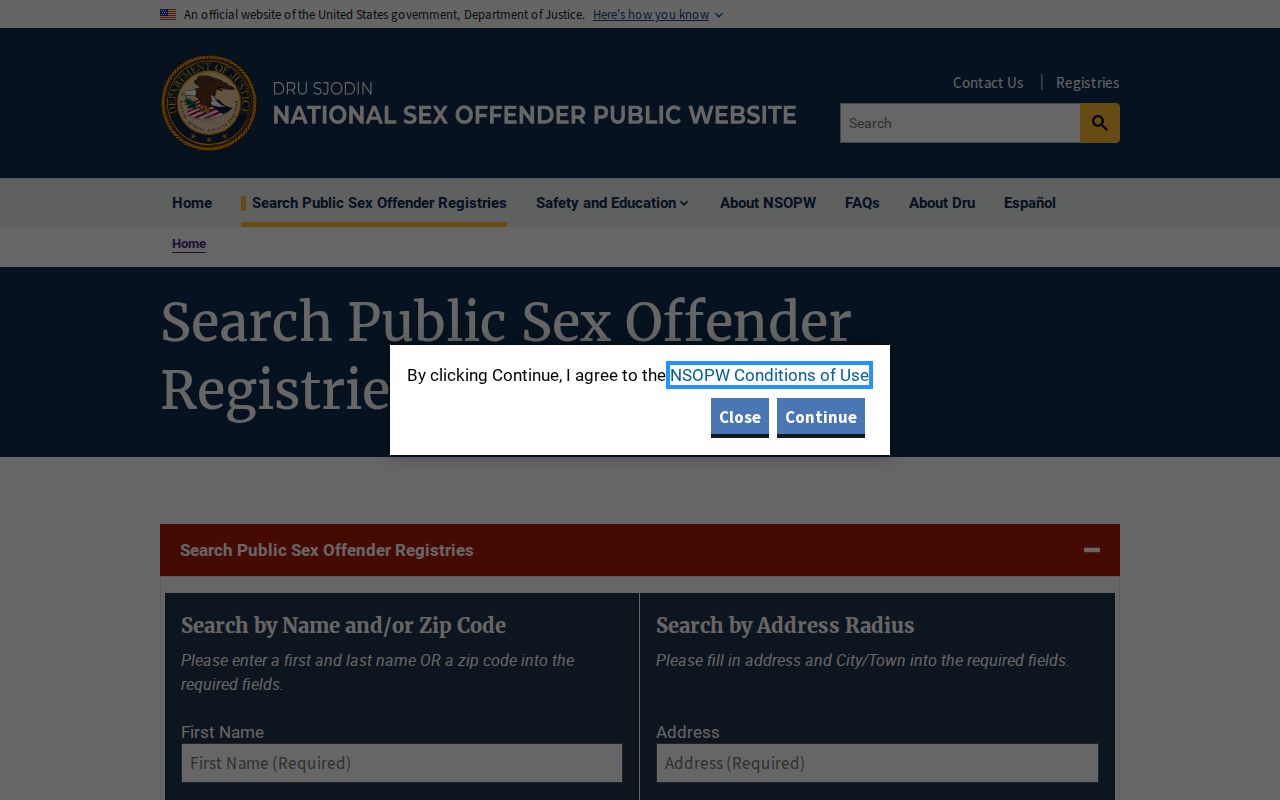
The official interface makes clear that name, ZIP, jurisdiction, and address-radius searches answer different questions. Broadening the place can catch a move across a nearby border.
Kane County Registry Identifier Check
Utah also provides a limited reverse check for a phone number, online identifier or address, or a website paired with an identifier. Its answer is deliberately narrow: whether that item is associated with an offender. It does not reveal the person's identity through the reverse query. That privacy boundary supports a focused family-safety check without turning an online handle into a public name lookup.
Do not try to defeat that design by combining unrelated sources or by confronting a person based on a yes-or-no response. If the result raises a safety concern, save the exact item entered and contact law enforcement through an official channel. The Sheriff main line handles local administrative questions, while 24-hour Kane County dispatch is 435-644-2349 or 877-644-2349.
Inside a Registry Profile
Utah Code §53-29-404 defines the public fields. Read them as separate facts. An address is reported registration data, not a promise that someone is at that spot at the instant of a search. An offense label needs its jurisdiction and registration history. The state also withholds victim identity and excludes some information from the general profile.
| Name and aliases | Current registered name plus other public names and aliases |
|---|---|
| Photo and description | Current photo, date of birth, height, weight, eye color, hair color, and selected identifiers |
| Residences | Primary, secondary, and temporary residence addresses |
| Vehicles | Make, model, color, year, and plate for owned or regularly driven vehicles |
| Offenses | Registrable offenses, read with the governing jurisdiction and sentence facts |
| Community fields | Professional licenses, Utah school affiliation, and volunteer locations when current law requires them |
| Protected details | Victim identity and general-profile online identifiers are not published |
The profile can also show a Utah educational affiliation, volunteer location, and professional license when current law calls for publication. None of those fields is a stand-alone risk score.
Kane County Registry Gaps
No result does not prove that no registration duty exists. Spelling, aliases, a recent move, another jurisdiction, and reporting delay can affect a query. Utah may maintain but not publish defined juvenile-origin records. Out-of-state juvenile information may also remain nonpublic when the adjudicating jurisdiction does not publish it. Public visibility and the duty to register are therefore not always the same.
A new rule effective July 1, 2026 adds monitoring under §53-29-406 for defined sex offenders who cannot provide residence information and whose offenses fall on or after the effective date. It includes time-linked location checks and warrant coordination for violations. It does not apply to every person on the registry, so a public search must not turn that narrow rule into a general label.
Use a careful fallback chain. Repeat the search with sound name variants, broaden the location, check NSOPW, and ask the Kane County Sheriff about a local administrative concern. Do not ask staff to disclose protected information. A public search can show what Utah law allows the public to see; it cannot convert a restricted record into a public one.
Utah Registration Levels and Requirements
Utah does not publish a federal Tier I, II, or III risk score for each profile. The state framework is ten years after termination of sentence or lifetime, depending on the qualifying offense and statutory history. Two or more registrable offenses can lead to lifetime registration. In defined cases, a court may convert lifetime registration to ten years for a person who was under 21 at the offense, but relief is not automatic.
Removal routes in §§53-29-204 through 207 can call for a BCI certificate of eligibility and a court petition. A public profile alone cannot show whether every requirement for relief is met. Searchers should not predict a removal date. The official Utah registration-duration statute supplies the controlling offense lists and exceptions.
| Utah category | Duration | Key limit |
|---|---|---|
| Ten-year registration | Ten years after sentence termination | Do not count from conviction alone |
| Lifetime registration | Life unless statutory relief applies | Offense and repeat history control |
| Other-jurisdiction duty | May follow that jurisdiction's remaining period | Only when Utah's conditions are met |
The Utah Legislature's current text is the source to check for the controlling duration rules.
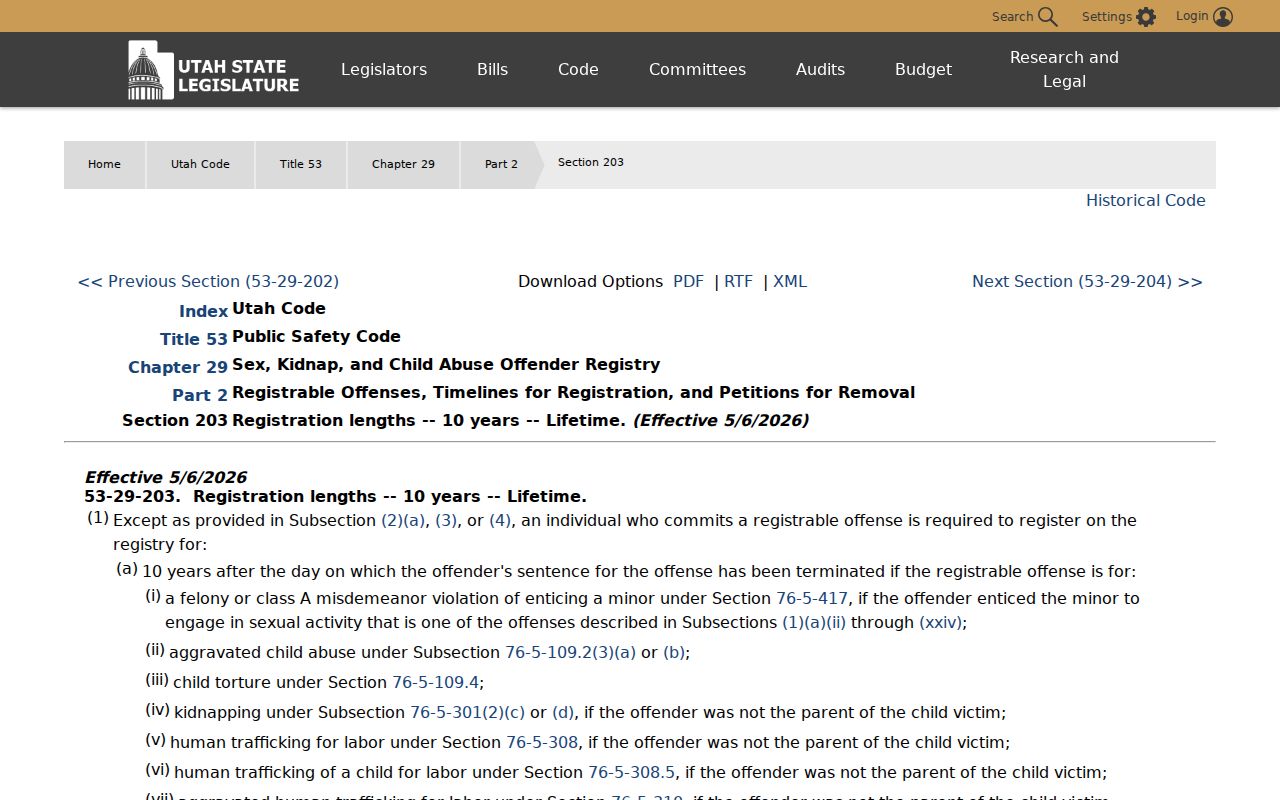
The statute image reinforces why adding ten years to a conviction date can be wrong. Incarceration, probation, or parole can move the sentence-termination date.
Kane County Registry Results Across State Lines
NSOPW is the official cross-state layer for searches involving a past address, a move, Indian Country, or a territory. It draws from participating jurisdictions rather than creating a new federal profile. Radius results depend on those jurisdictions supplying usable coordinates, so a name and ZIP search can still be valuable when a map search is thin.
Utah can also apply another jurisdiction's remaining registration period when statutory conditions are met. That does not mean the public should calculate a person's end date. Sentence termination, repeat history, court relief, and the source jurisdiction can all matter. Use the profile and the current statute, then direct an official duty question to the registering agency.
Reporting Kane County Registry Concerns
Report suspected noncompliance through Kane County Sheriff, 24-hour dispatch, or the official tip route. State what appears wrong and let staff compare protected and public data. Do not visit a listed home, confront anyone, or circulate a claim that the official profile does not support.
A stale address does not show why the data differs. A move may be in its reporting window, information may still be moving between jurisdictions, or the public view may omit a protected detail. Sheriff staff can review the local registration process; DPS controls the statewide public website.
Community Notification and Lawful Use
The registry exists for community awareness and safety planning. Review a result calmly, confirm the identifiers, and use law enforcement when a listing seems stale or a duty may not be met. Utah requires users to affirm that they will not harass, stalk, threaten, or intimidate a registrant or the person's family. Ordinary Utah criminal laws can apply to that conduct.
The Utah public-registry statute identifies the public fields, disclaimer, reverse-identifier response, redactions, and juvenile nonpublication rules.
Registry misuse is unlawful: Never use Kane County registry information to harass, stalk, threaten, intimidate, or take vigilante action against a registrant or household.
The official Utah Legislature page shows the public-website rule behind those limits.
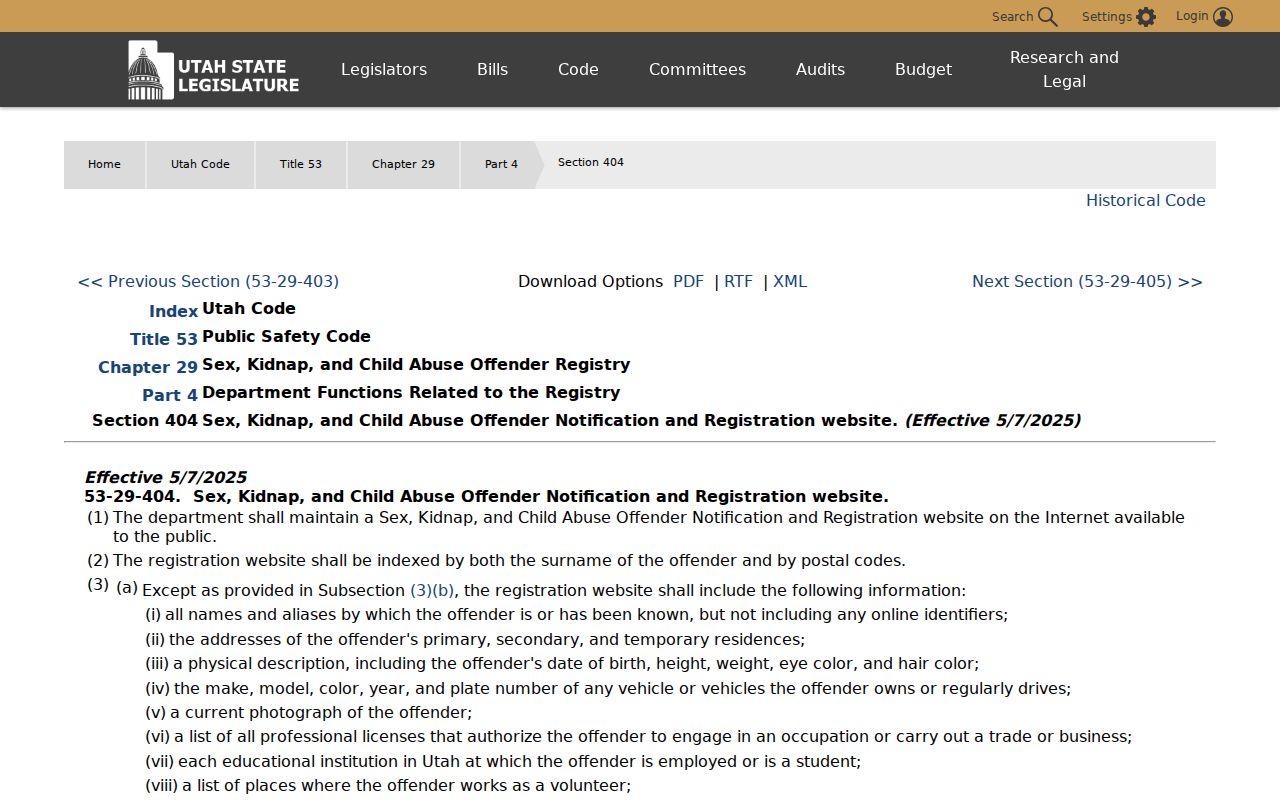
The law pairs public access with limits on what is published and how the data should be understood.