
Kane County Criminal Court Cases
Three local desks may hold a Kane County criminal court file. The Sixth District Court in Kanab hears all felonies and class A misdemeanors. Its clerk is at 76 North Main Street, Suite 2, and can be reached at 435-264-4790 or 6thkanedocs@utcourts.gov. The Kane County Justice Court, also at 76 North Main, hears class B and C misdemeanors, infractions, and many traffic, wildlife, boating, OHV, snowmobile, trucking, and ordinance matters from unincorporated Kane County, Kanab, and Alton.
Orderville Justice Court keeps a distinct lower-level docket for its local jurisdiction. Its mailing address is PO Box 165, Orderville, UT 84758, and its number is 435-648-2534. Court territory matters because a Kane County case number is not unique statewide. The clerk that accepted the complaint or citation is the custodian of that case file. Sheriff reports and jail booking records remain at Kaneplex, even when they concern the same event.
Match Kane County Charges to Court
The charge class is the fastest way to choose a Kane County court. First-, second-, and third-degree felonies all begin in Sixth District Court. Class A misdemeanors go there as well. Class B and C misdemeanors and infractions are justice-court matters, but territory then separates Kane County Justice Court from Orderville Justice Court.
| Filed level | Kane County court | Possible Utah maximum |
|---|---|---|
| First-degree felony | Sixth District Court | Five years to life unless another statute controls |
| Second-degree felony | Sixth District Court | One to 15 years |
| Third-degree felony | Sixth District Court | Up to five years |
| Class A misdemeanor | Sixth District Court | Up to 364 days |
| Class B or C, infraction | Justice court by territory | Up to six months, 90 days, or no jail |
A charge label is an accusation, not a result. Read the plea and disposition fields before drawing any conclusion about a Kane County criminal court case.
Searching Kane County Case Records
Utah Courts Xchange is the paid statewide public search for district and justice court information. A guest begins with a $10 credit; the stated rate is $0.35 per search and $1 per document. A subscription costs $25 to set up and $40 per month, includes 500 searches, and then uses the same per-search rate. A free public Xchange terminal may be available at the district courthouse, so call before a long trip.
- Choose district court, justice court, or both, then limit the scope to Kane County or a named local court.
- Enter a case number, surname, or citation number. Add a first name when it helps separate close matches.
- Narrow common names with birth date, case type, court, or filing and disposition dates.
- Open the result, read the chronological case history, and review public electronic documents where offered.
- Ask the clerk for a public file or submit the judicial court-record request when Xchange does not offer the needed document.
| Field label | Type | Required | Format or use |
|---|---|---|---|
| Jurisdiction | Choice | Unspecified | District, justice, or both |
| Search Type | Choice | Unspecified | All cases or judgments only |
| Case Number | Text | Conditional | Not unique statewide |
| Last Name/Company | Text | Conditional | Surname exactness matters |
| First Name | Text | Optional | An asterisk can broaden variants |
| Case Type | Dropdown | Optional | Official codes narrow results |
| Scope | Dropdown | Optional | State, county, or court |
| Birth Date | Date | Optional | Useful for criminal defendants |
| Citation Number | Text | Conditional | Pair with citation location |
| Date category | Control | Optional | Filing, disposition, or judgment |
Read Kane County Xchange Results
The official Xchange help page explains the search screen, results, case history, and document controls. The captured official interface below gives Kane County readers a visual reference before they open a paid search.
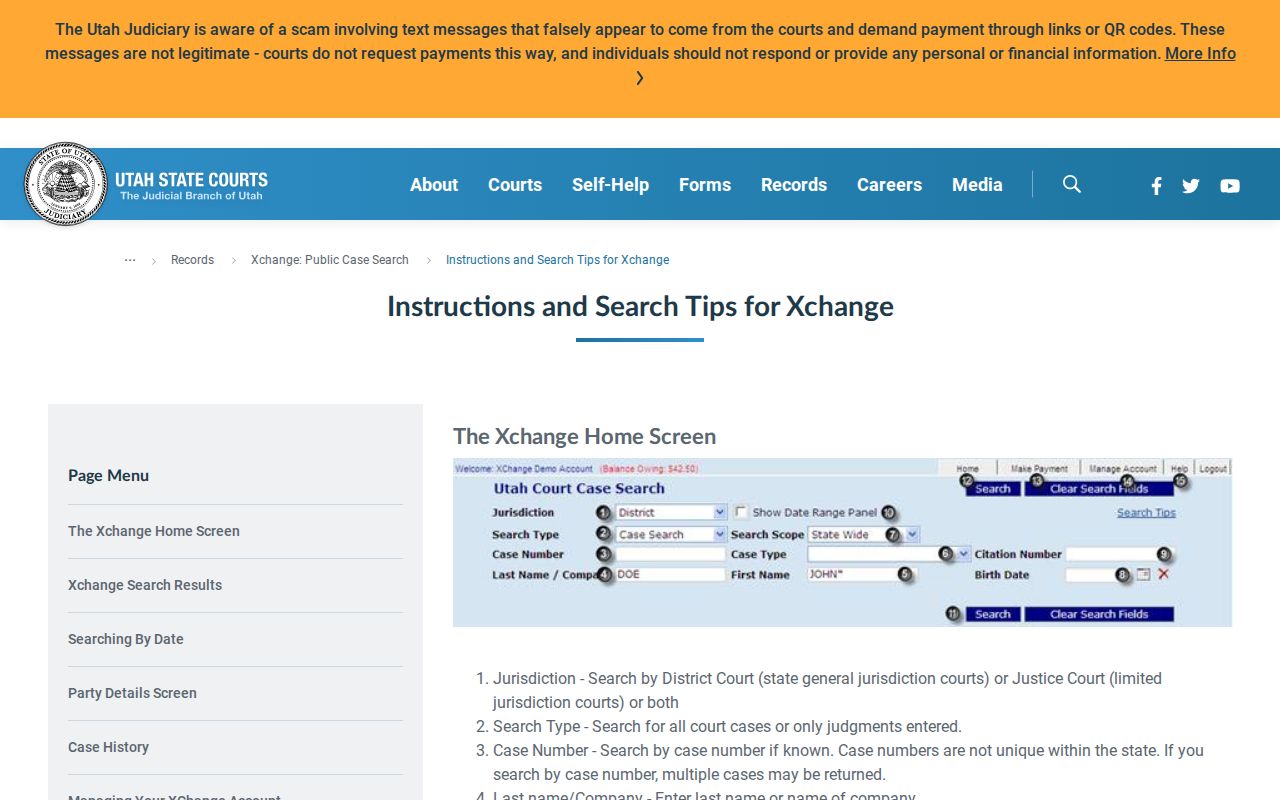
Use the court, case type, filing date, party role, and birth date to confirm a result before buying a document. Xchange can return no more than 500 results, so broad common-name searches need tighter fields. The first two digits of a case number generally reflect its filing year.
For a party reviewing their own supported case, MyCase is free and can include filed documents after identity and account setup. It is not a public name-search substitute. A public Xchange record and a party's MyCase view can expose different document sets.
Inside a Kane County Case File
A Kane County criminal case file ties a charge to what the court did with it. Xchange may show the court and caption, assigned judge, parties and roles, attorneys, the defendant's date of birth, law-enforcement and prosecuting agencies, citation data, charge levels, pleas, outcomes, a dated case history, account summaries, and public electronic documents. The details below keep the key fields distinct.
| Case number and court | Identifies the local file and the district or justice court that owns it. |
|---|---|
| Charging document | The complaint or information states the formal counts filed, which may differ from arrest allegations. |
| Docket entries | A dated history of filings, hearings, motions, orders, and other court events. |
| Hearing dates | Scheduled and completed proceedings, including arraignment and later settings. |
| Plea and disposition | Separate fields for the defendant's response and the outcome of each charge. |
| Sentence and accounts | Court consequences plus public fine, fee, due, paid, balance, revenue, or trust entries. |
An address can appear when it was filed on a public case. Protected data may be redacted. The presence of a charge, an arresting agency, or a prosecutor does not by itself establish a conviction.
Kane County Case Dates Can Mislead
The violation date, arrest date, filing date, plea date, disposition date, and judgment date mark different events. A traffic or criminal citation can identify conduct that happened days before the clerk opened the court case. A later plea may still precede the final outcome. Searchers who use only one date can miss the right Kane County court record or mistake an old event for a new filing.
- Arraignment
- The hearing at which the charge is addressed and a plea may be entered.
- Plea in abeyance
- A plea held subject to conditions rather than treated at once as a final conviction.
- Disposition
- The outcome of a charge, such as conviction, acquittal, or dismissal.
- Minute entry
- The court's record of action taken at a hearing.
- Restitution
- A court-ordered payment tied to a loss.
Read each count separately. One Kane County case can contain several charges with different pleas, outcomes, and sentence terms.
How a Criminal Case Moves
A citation or arrest may precede the court record, but the formal Kane County case begins when a complaint or information is filed. An initial appearance addresses the person's first court contact and release questions. At arraignment, the filed charge is read or acknowledged and the defendant responds. Motions and pretrial work may test evidence, set terms, or narrow the dispute. The matter then reaches a plea or trial, followed by a disposition and any judgment or sentence. An appeal can create a further record outside the trial file.
Case flow: Charges Filed › Arraignment › Pretrial › Plea or Trial › Disposition › Sentencing
The court file is the source for this chain. For the separate custody event and agency record, consult the Kane County arrest lookup channels.
When Kane Court Documents Are Missing
Xchange may list a Kane County criminal case without offering every public document as a PDF. The proper fallback is the court, not a Sheriff GRAMA request. Utah Courts provides a Request for Court Record route for material that cannot be retrieved online. Give the clerk the case number, court, party name, and a clear description of the item.
Sixth District Court
76 North Main Street, Suite 2
Kanab, UT 84741
435-264-4790
6thkanedocs@utcourts.gov
Kane County Justice Court
76 North Main Street
Kanab, UT 84741
435-644-2351
Tuesday hearings at 9 a.m. Mountain
Utah's largest judicial district spans vast ground, with an official example of a 315-mile Bullfrog-to-Kanab trip. Phone, email, scanned copies, Webex, and the public terminal can be core access tools for Kane County residents.
Kane County Recovery Court Path
Kane Recovery Court creates a named collaborative route inside the local court system. The County Attorney administers the program with the judge, prosecution, defense, case management, treatment, and supervision roles. It does not erase the court file or turn it into a jail record. The docket can still reflect filings, hearings, court orders, progress events, and a final outcome that must be read in context.
That distinction matters when reviewing a Kane County criminal court case. A program entry may describe a treatment-focused court step, not a new charge. Check the chronological history and the disposition for each count. If an entry is unclear, ask the handling clerk what public document records the action rather than assigning a meaning to a short docket label.
Case Record Access and Restrictions
Utah court rules allow any person to access public court records, but not every Kane County case or field is public. Expunged, sealed, juvenile, adoption, and other private cases do not appear in Xchange. Victim-identifying facts, private personal data, or information tied to an active matter can also be withheld or redacted. An empty result therefore does not prove that no event occurred.
Ask the clerk whether the search used the right court, name, date, and case type. A person reviewing their own eligible case may also check MyCase. If a record has been expunged, public Xchange should not show it, though the order seals or restricts access rather than physically destroying every copy.
Note: Court access rules govern Kane County case files, while GRAMA governs many executive-agency records held by the sheriff or police.